Meknes was once the seat of Moulay Ismail's vast 17th-century empire. Today it is the most affordable of Morocco's four imperial cities and the natural base for visiting Volubilis, North Africa's finest Roman ruins.
The Imperial City That History Overlooked
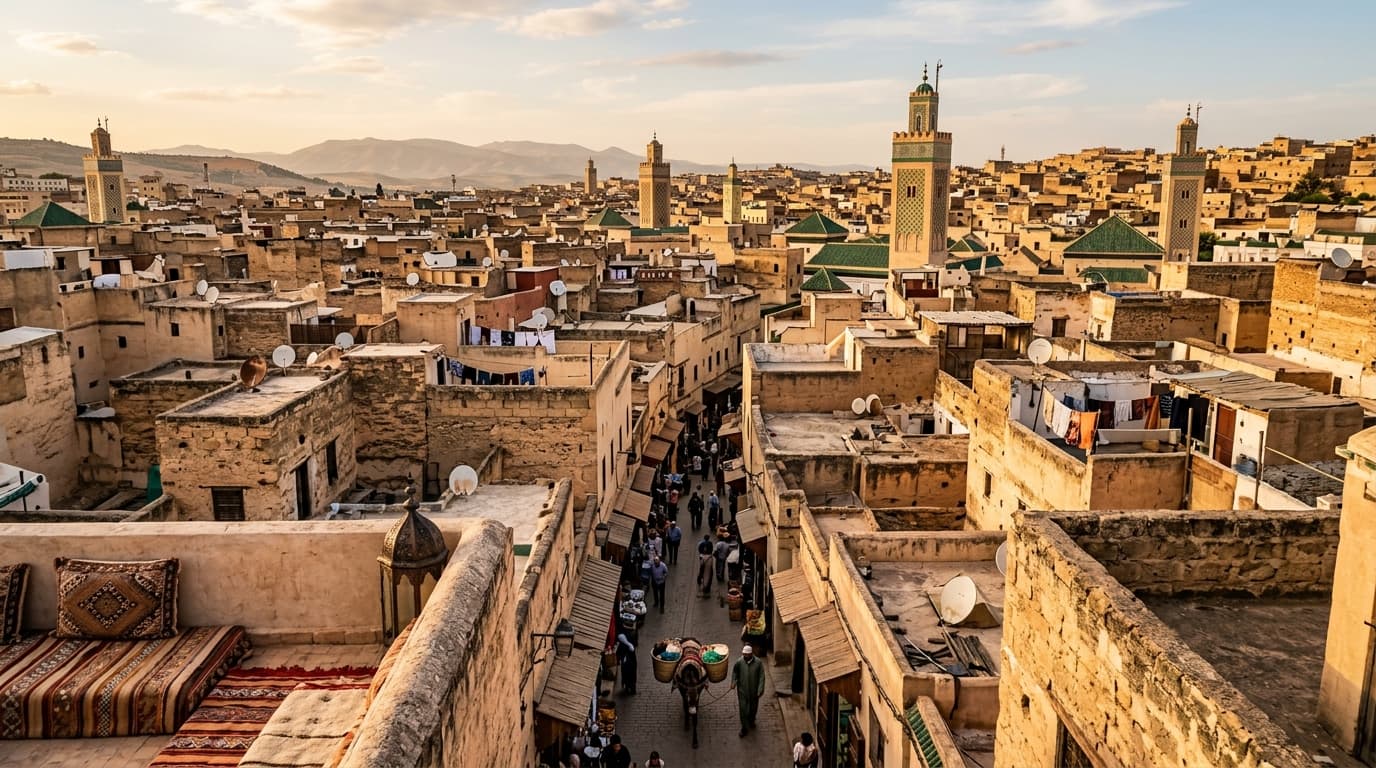
Meknes was built to outshine every city in the Islamic world. Sultan Moulay Ismail, who ruled Morocco from 1672 to 1727, chose a modest market town in the middle of Morocco's most fertile plain and transformed it over five decades into an imperial capital of extraordinary scale — 25 kilometres of walls, monumental granaries, a palace complex larger than Versailles, and a series of gates decorated with a precision of tilework and carved stucco that has never been surpassed. Then Moulay Ismail died. A 1755 earthquake damaged much of the imperial quarter. Fes reasserted its historical prestige, Marrakech captured the tourist imagination, and Meknes was left with its monuments largely intact and almost entirely unvisited by the international travellers who pack into the other three imperial cities every morning.
Bab Mansour: The Gate That Defines Moroccan Architecture
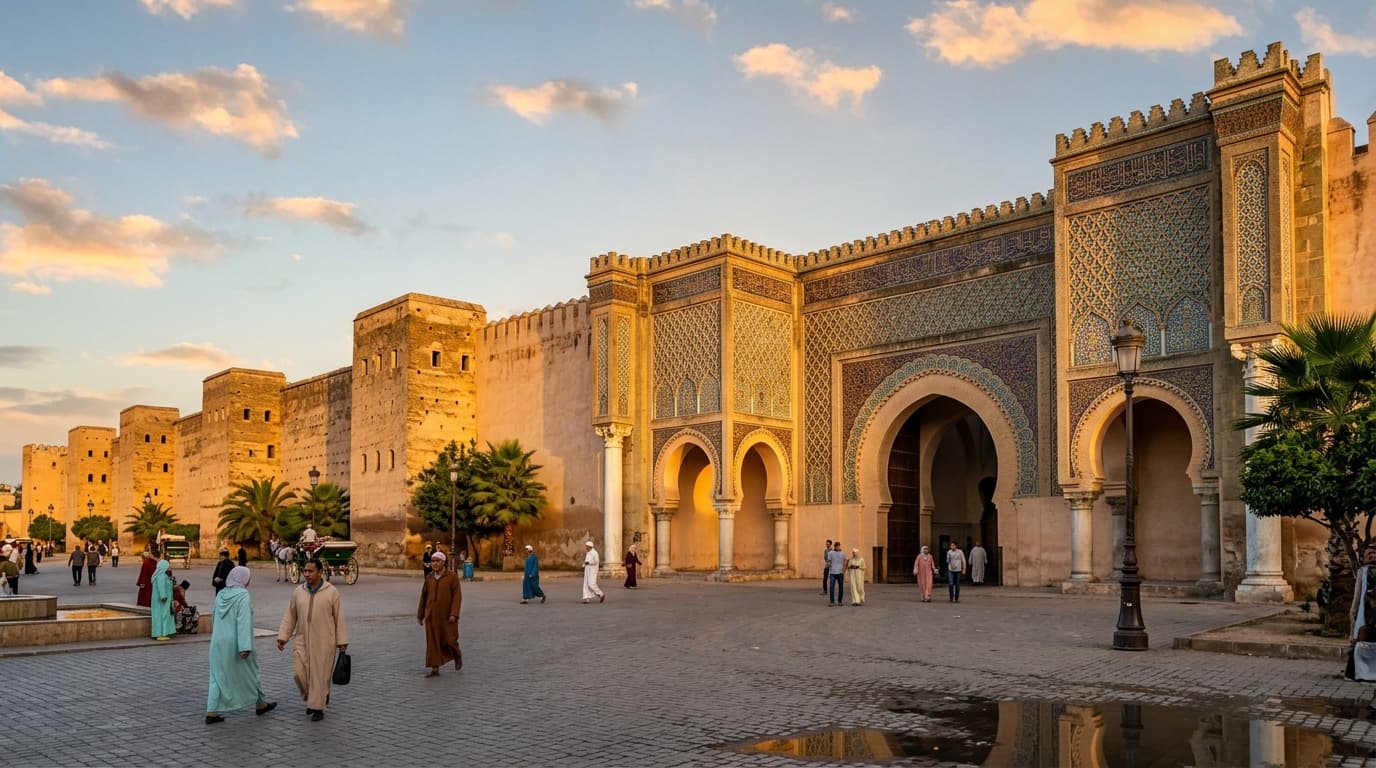
Bab Mansour was completed in 1732, five years after Moulay Ismail's death, under his son. It stands at the entrance to the imperial quarter of Meknes and is, by most informed assessments, the most ornate gate in Morocco. The entire facade — three storeys of horseshoe arches and flanking bastions — is covered in geometric zellige tilework and carved stucco panels. Four Roman columns looted from Volubilis frame the central arch. The name honours its architect, a Christian convert to Islam known as Mansour el-Aelj, who gave his patron something that outlasted the dynasty by three centuries. Standing in Place el-Hedim in front of it at any hour, the gate looks exactly as it did when it was built.
Meknes in Numbers
1732
Year Bab Mansour was completed
25 km
Length of Moulay Ismail's city walls
33 km
Distance to Volubilis Roman ruins
30-40%
Lower prices in Meknes medina versus Fes
UNESCO
World Heritage listing shared with Fes (1996)
700,000
Approximate population of greater Meknes
The Heri es-Souani and Agdal Basin
A short walk from Bab Mansour, the Heri es-Souani is a granary complex of extraordinary size — a series of vast vaulted underground chambers built to store grain for Moulay Ismail's army of 150,000 soldiers and his legendary stables, said to have housed 12,000 horses. The construction was engineered to maintain a constant cool temperature regardless of external heat; the vaults are thick enough that even in midsummer the interior is noticeably cooler than the street. Beside the granary, the Agdal Basin is an artificial reservoir, 400 metres by 200 metres, which still holds water today and was originally used to irrigate the royal gardens. In the late afternoon, locals sit on its edges. The combination of granary and basin takes around an hour to explore.
Volubilis: North Africa's Best Roman Ruins, 33km North
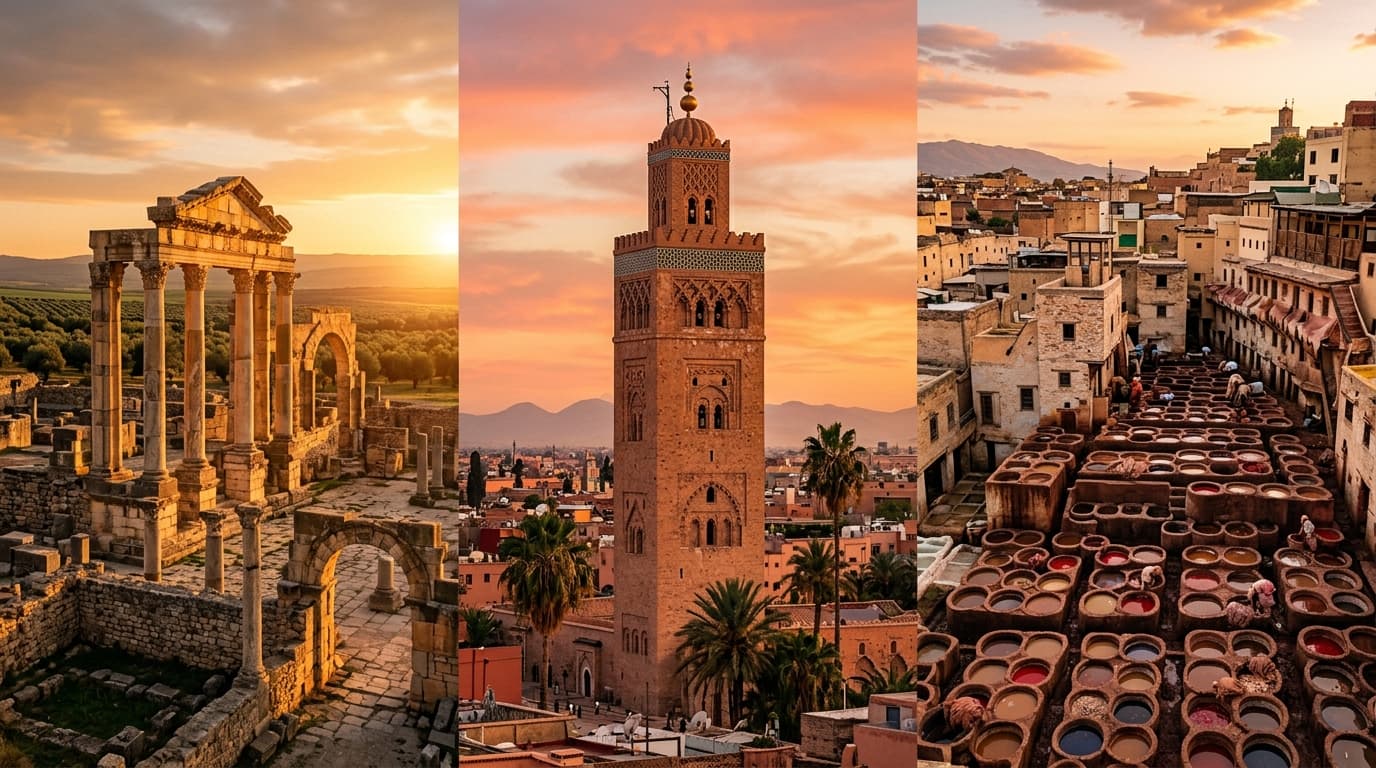
Volubilis was a prosperous Roman city at the edge of the empire — a place where olive oil, grain, and wild animals destined for the amphitheatres of Rome were processed and shipped north. It reached its peak in the 2nd and 3rd centuries AD. What remains today, on an open plain below the Zerhoun mountains, is the most complete Roman site in North Africa: a triumphal arch, the foundations of the forum and basilica, baths with original heating systems still visible, and above all, the floor mosaics. Volubilis has more in-situ Roman mosaics than anywhere in Morocco — Dionysus, dolphins, athletes, geometric patterns — preserved in rooms open to the sky, entirely accessible. A two-hour visit is the minimum. The site is easy to combine with Meknes in a single day from Fes, 60 kilometres to the east.
We spent a morning at Volubilis and then drove into Meknes for the afternoon. The medina was nothing like Fes — no touts, normal prices, people going about their day. We bought better spices for less money and found a restaurant where we were the only tourists.
One Day from Fes: Meknes and Volubilis
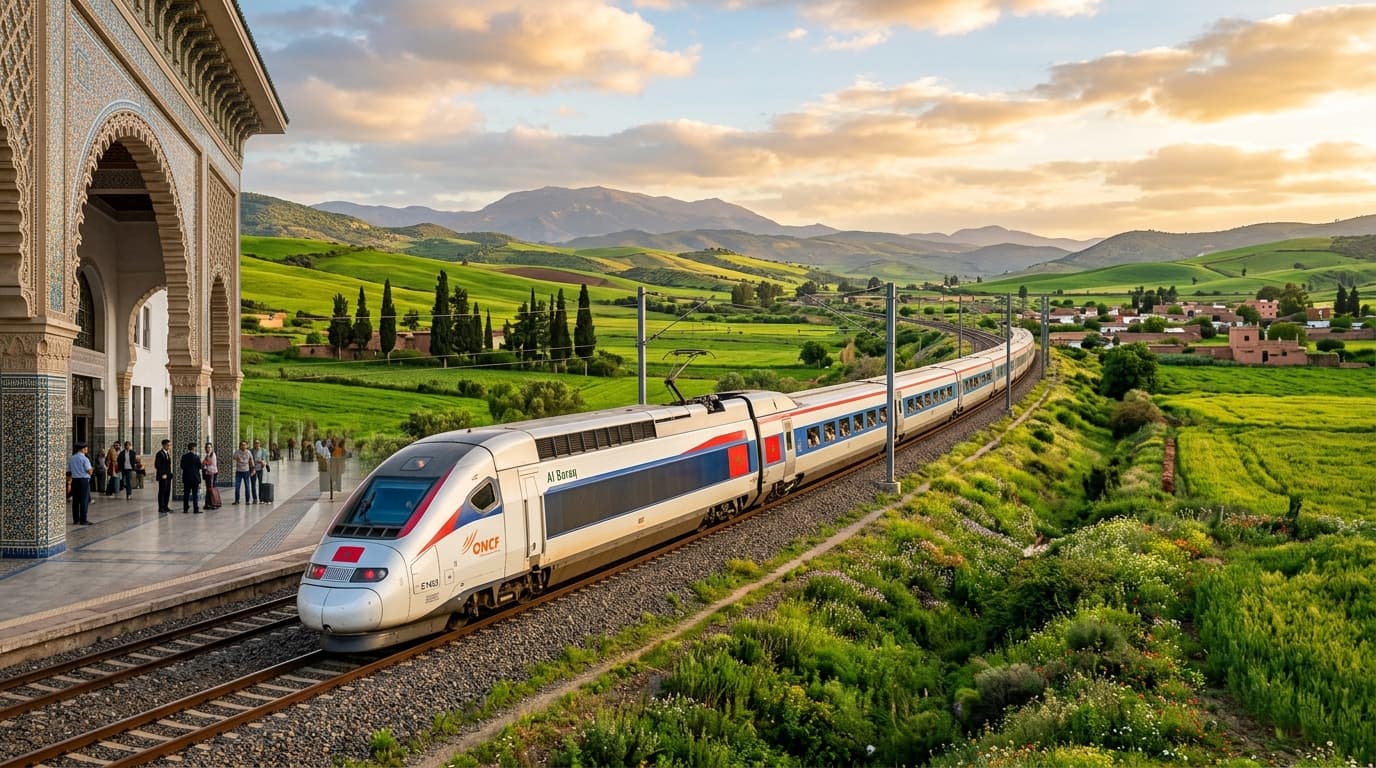
- Depart Fes by 8am — drive or take a grand taxi to Meknes (60km, around 1 hour)
- Arrive Meknes: start at Place el-Hedim, visit Bab Mansour, then the Heri es-Souani granary complex
- Lunch in Meknes medina — the restaurants around Place el-Hedim serve a full Moroccan lunch for 60-80 MAD per person
- Drive north to Volubilis (33km, 35 minutes) — arrive early afternoon when the light is better for the mosaics
- Allow two full hours at Volubilis; the site closes at sunset
- Return to Fes via Meknes or directly on the N6 road — total round trip from Fes is around 180km
Staying in Meknes: Riad Yacout
Riad Yacout is inside the medina walls, a ten-minute walk from Bab Mansour. It is one of the few genuinely restored riads in Meknes — most accommodation in the city is budget hotel rather than riad. Prices run 30-40% lower than equivalent properties in Fes. Staying in Meknes rather than Fes gives you the medina almost to yourself in the early morning.