Djemaa el-Fna is the most famous food square on the continent, but Marrakech's best eating happens in the lanes beyond it. A local food lover's guide to eating well for under 100 dirhams.
The Square That Started It All
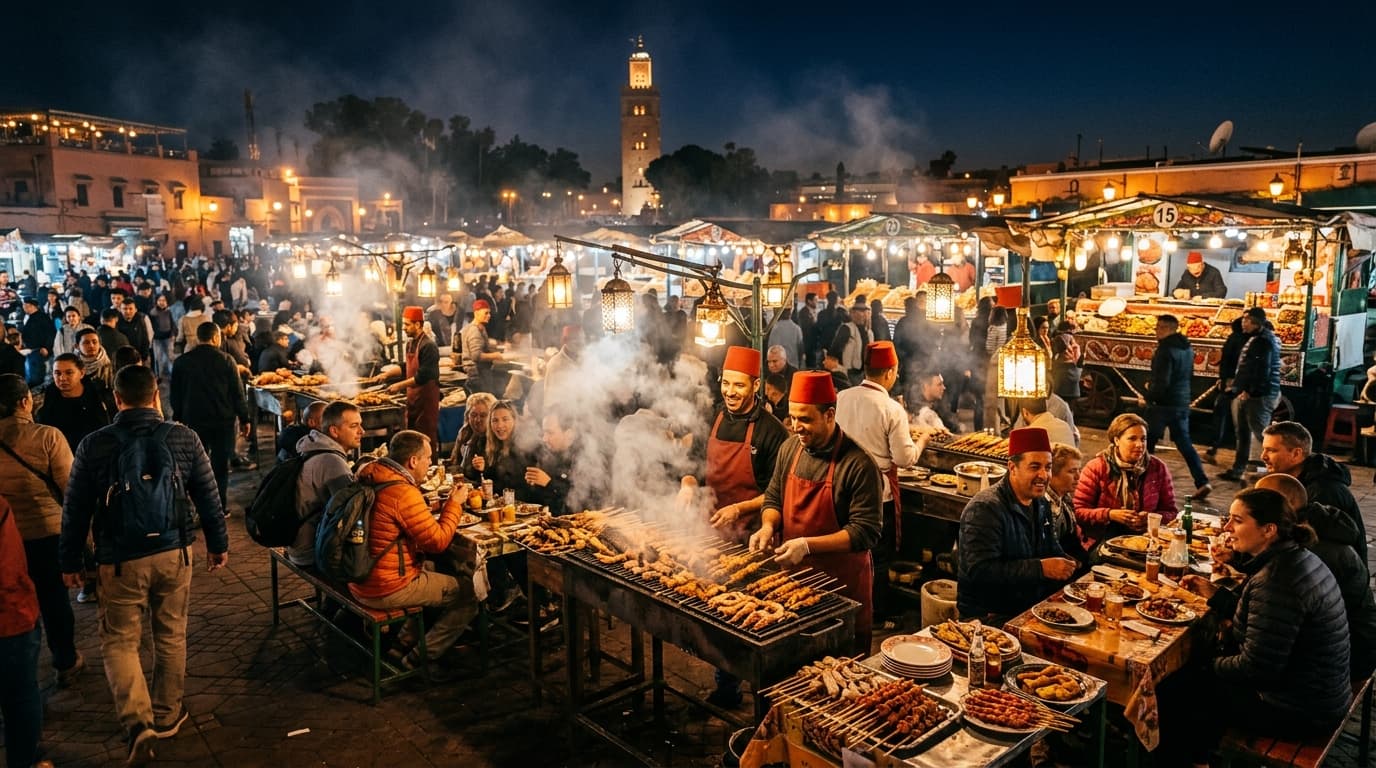
Djemaa el-Fna — which translates, with characteristic Moroccan pragmatism, as 'Assembly of the Dead' — has been the beating heart of Marrakech since the 11th century. In the evening it transforms into one of the most electric food environments on earth: more than a hundred numbered stalls materialise at dusk, each with its own chef, its own speciality and its own team of persuasive young men calling from the front. The smoke, the sound, the competing aromas and the press of people is overwhelming on first encounter. Sit down, order slowly, and ignore anyone who tries to rush you. Stalls 1 through 14 tend to cluster the more tourist-facing menus near the northern edge; walk south and slightly east for stalls that local families actually use.
Marrakech Street Food by the Numbers
5 MAD
Bowl of snail soup (babbouche)
8 MAD
Bowl of harira soup
15–20 MAD
Kefta sandwich on khobz
100+
Evening stalls in Djemaa el-Fna
4 MAD
Fresh-squeezed orange juice (Mellah)
1,000
Years the square has operated
Snail Soup: The Correct Marrakchi Order
If you eat one thing in Djemaa el-Fna, let it be harira or snail soup — not the lamb kebab that every stall tries to sell you. Babbouche, the Moroccan word for the garden snails cooked in a spiced broth of thyme, liquorice root, wild mint, cumin and chilli, is served in a small bowl with a toothpick for extraction. It costs 5 dirhams per bowl and it is one of the most distinctive flavours in Moroccan street cooking. Harira, the tomato-chickpea-lentil soup thickened with a flour slurry, is the other essential order. Both are found at small dedicated stalls around the edges of the square and in the lanes leading toward the souks, often marked by a large copper pot and a queue of Moroccans.
I came to Marrakech expecting the tagines in the restaurants. What I did not expect was a 5-dirham bowl of snail soup at a counter with no sign, eaten standing up at 10 p.m. next to a market porter who had clearly been eating there for decades. That was the real meal.
Rue Bab Agnaou and the Sandwich Strip
The lane running south from Djemaa el-Fna toward Bab Agnaou is locally known as the sandwich strip, though it has no official name. Here, a series of hole-in-the-wall counters produce the Moroccan kefta sandwich: a long Khobz roll stuffed with grilled ground beef or lamb seasoned with cumin, paprika and flat-leaf parsley, then dressed with merguez harissa and a raw egg cracked directly onto the hot griddle beside the meat. The whole process takes three minutes and costs 15 to 20 dirhams. For dessert, the pastry counters nearby sell msemen — griddle-fried flatbread layered with butter and honey — and chebakia, a sesame and honey pretzel eaten during Ramadan but available year-round. Neither costs more than 5 dirhams.
The Essential Street Food Checklist
- Babbouche — snail soup in spiced broth, 5 MAD, eaten with a toothpick
- Harira — tomato, chickpea and lentil soup, 8 MAD, look for the copper pot
- Kefta sandwich on khobz with raw egg cracked onto the griddle, 15–20 MAD
- Bissara — fava bean soup with argan oil and cumin, 8–10 MAD, morning only
- Msemen with honey and butter, 5 MAD, from pastry counters near the square
- Fresh orange juice at the Mellah, 4 MAD — 15 MAD at any stall on the square is tourist pricing
- Nous-nous coffee (half espresso, half warm milk), 7–10 MAD at any medina cafe
The Mellah Spice Market and Morning Bissara
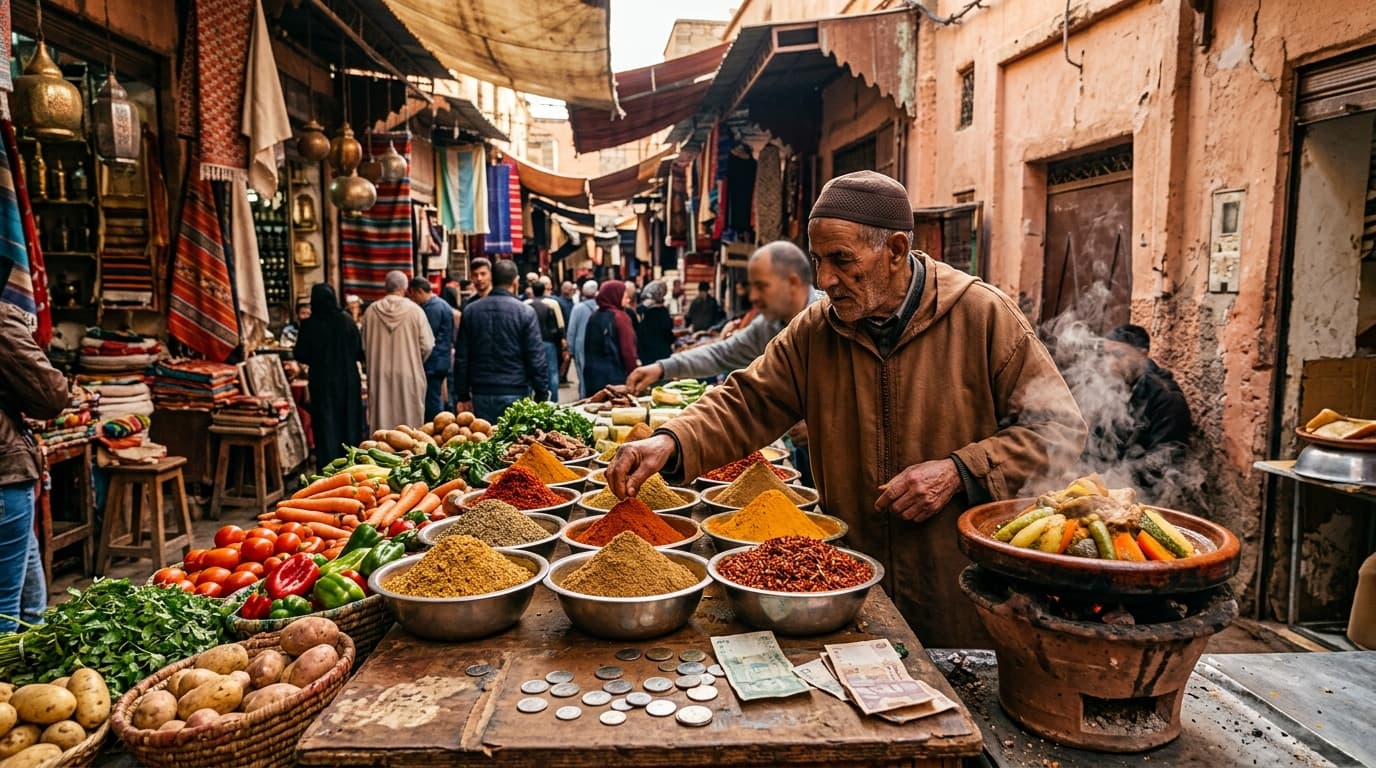
The old Jewish quarter of Marrakech, the Mellah, sits adjacent to the Royal Palace and is overlooked by most visitors who rush directly from Djemaa el-Fna to the souks. Its covered market runs along two parallel streets and is almost entirely given over to spice merchants, olive sellers and the dried fruit and nut vendors who supply the riad kitchens of the city. Come early — before 9 a.m. — and you will find the handful of simple cafes along the Mellah's main lane serving bissara, a thick fava bean soup drizzled with cold-pressed argan oil and dusted with cumin and sweet paprika. This is the working man's breakfast of Marrakech, deeply filling, cheap at 8 to 10 dirhams and utterly without the performance of the tourist-facing places.
The Souk Lunch Spot No One Tells You About
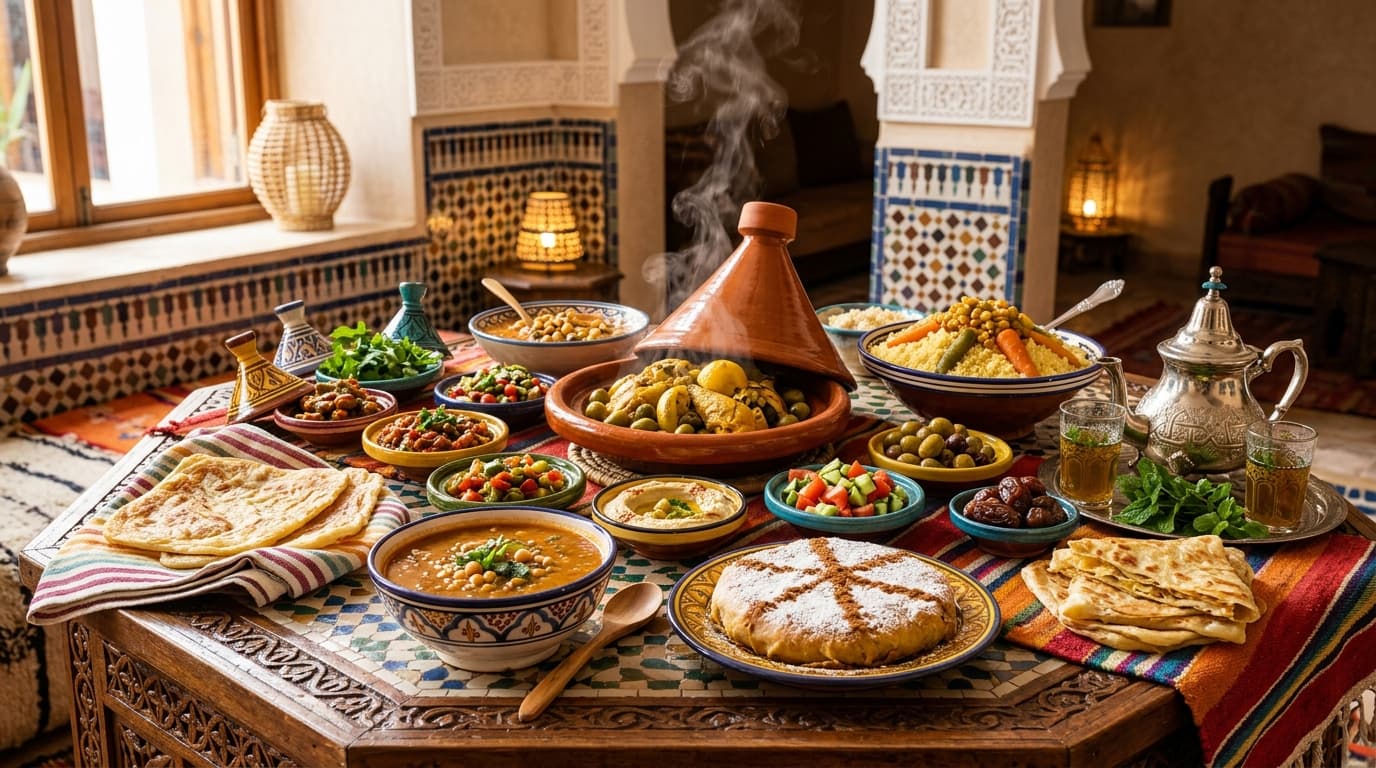
Navigating to a restaurant called Chez Brahim requires either a guide or a willingness to become completely lost in the northern souks, roughly halfway between the Medersa Ben Youssef and Souk el-Kebir. It has no sign, six tables, a menu of three dishes that changes daily and a proprietor who has been cooking the same Marrakchi dishes — mrouzia (lamb with honey and almonds), pastilla (pigeon pie in paper-thin warka pastry dusted with cinnamon sugar) and a tagine of the day — for longer than most of the nearby boutique riads have existed. The pastilla alone is worth the navigation effort: the contrast of savoury pigeon, egg and onion filling against the sweet exterior crust is one of the true achievements of Moroccan cuisine.
How to Identify a Local Stall vs a Tourist Trap
The clearest indicator is who is sitting at the counter. If Moroccan families and workers make up the majority of diners, the price is honest and the food is good. A laminated photo menu displayed in three languages and a tout outside calling you in from the street are the two clearest signs of a tourist-facing operation charging three to four times the local rate.
Fresh Juice, Coffee and Avoiding the Tourist Traps
Marrakech has one of the world's great orange juice traditions: the city sits close to some of the finest citrus groves in Morocco, and the fruit is sweet, acidic and juicy in a way that supermarket oranges never are. Fresh-squeezed orange juice should cost 4 dirhams in the Mellah and up to 8 dirhams at a clean stall in Djemaa el-Fna. Anything above 15 dirhams is being sold to tourists at triple the local price. Coffee is taken as nous-nous — half espresso, half warm milk, served in a small glass — and costs 7 to 10 dirhams in any cafe not directly facing the square. The rip-off establishments are easy to identify: laminated photo menus, a menu in four languages prominently displayed facing the square and a member of staff positioned outside to wave you in.
Eating Etiquette and Practical Guidance
Moroccan street food culture is communal and unhurried. Do not eat standing up if a stool is available — the vendor will offer one. Eat with your right hand if you are eating anything by hand, as the left hand is considered unclean in Moroccan etiquette. Bargaining is not appropriate at food stalls where prices are displayed; push back only if you are being charged a visibly different price than the Moroccan seated next to you. Stomach safety is a real concern: stick to food that is freshly cooked in front of you, avoid salads rinsed in tap water and be cautious with shellfish from stalls without high turnover. The locals in Djemaa el-Fna know which stalls maintain standards; following where Moroccan families sit is the simplest quality guarantee available.