Morocco is one of the most rewarding budget destinations in the world — if you know the system. Here is how to eat well, sleep well and see everything for under 600 dirhams a day.
What Budget Travel Actually Means in Morocco
Morocco occupies an unusual position in global budget travel: it is genuinely cheap by European standards, but it has a well-developed tourism infrastructure that allows prices to vary enormously for the same product depending on where you buy it and how you ask. A night in a Marrakech medina guesthouse can cost anywhere from 120 dirhams to 2,000 dirhams, a mint tea from 5 to 50, and a tagine from 35 dirhams at a working-class canteen to 250 at a tourist-facing riad restaurant. The gap is not about quality — it is about who you appear to be and where you buy. The core skill of budget travel in Morocco is learning the local price for everything, which requires a day of observation before the first purchase.
Realistic Budget Benchmarks (2025 Prices)
120–250 MAD
Basic medina guesthouse per night
30–50 MAD
Three-course lunch at a workers' canteen
100 MAD
CTM bus: Marrakech to Ouarzazate (3 hrs)
4 MAD
City bus from Marrakech airport to Djemaa el-Fna
10 MAD
Entry to Chellah ruins, Rabat
120 MAD
Hassan II Mosque guided tour, Casablanca
Getting There Cheaply
Morocco is one of the most competitively priced short-haul destinations from Europe. Ryanair, easyJet, Transavia and Vueling all fly to Marrakech Menara, Agadir Al Massira, Fez-Saiss and Casablanca Mohammed V. Return fares from UK and European cities frequently drop below £60 with two to three months of advance booking. The key is flexibility on days: Tuesday and Wednesday departures are consistently cheaper than Friday and Sunday. For entry into Morocco at the airport, the Marrakech petit taxi rate into the medina is 70 to 80 dirhams during the day and 90 to 100 dirhams at night — agree the price before getting in, as meters are used inconsistently. The bus (No.11 or No.19) costs 4 dirhams and takes 40 minutes to Djemaa el-Fna.
I spent eleven days in Morocco in April — Marrakech, Fez, Chefchaouen and the Sahara — and came in at under 5,000 dirhams total including a one-night desert camp. The trick was always eating where the workers ate and never buying anything from a stall that had its prices in euros.
Where to Sleep Without Overpaying
Medina guesthouses — not branded riads, but the unlabelled dar (house) that a family rents out — are the best value accommodation in Morocco. In Marrakech, the streets running north of Djemaa el-Fna toward the Mouassine neighbourhood contain dozens of clean, family-run rooms at 150 to 250 dirhams per night. The best way to find them is to walk in the morning with a bag and knock; turning up on foot signals that you are not dependent on a booking platform with commission overhead built into the price. In Fez, the area around Rcif neighbourhood and the lower Andalusian quarter has cheaper guesthouses than the over-touristed Talaa Kebira zone. In Chefchaouen, almost any guesthouse you walk into in the medina will be clean and well below 300 dirhams in the shoulder season.
Eating for Under 100 Dirhams a Day
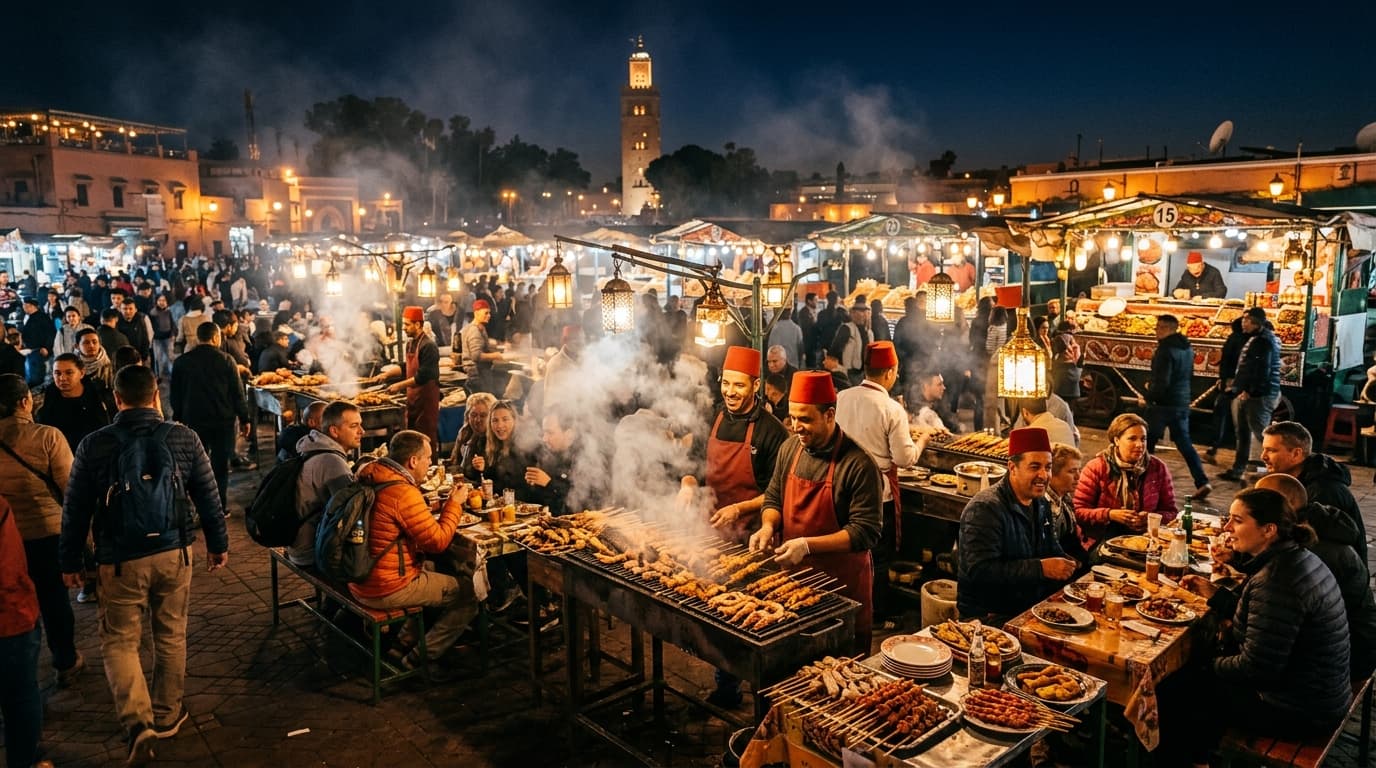
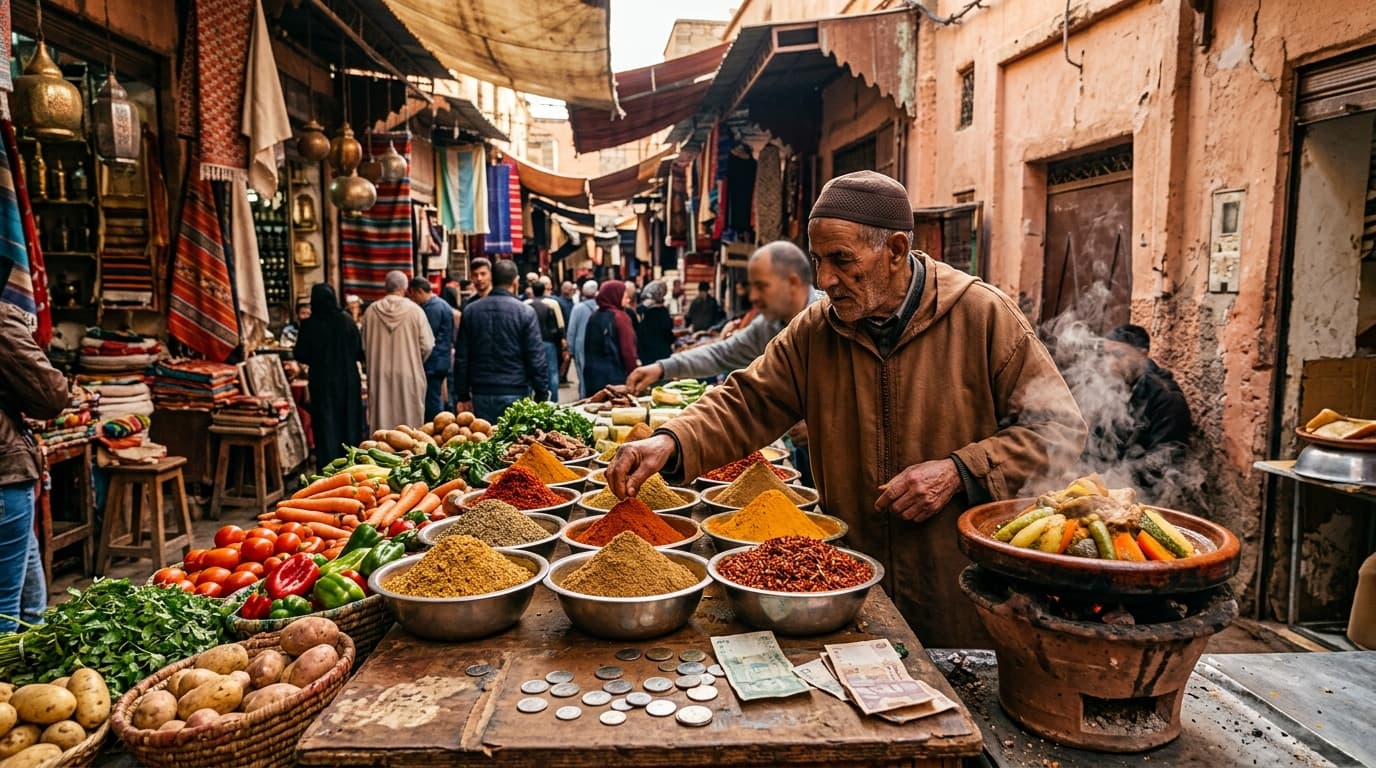
This is entirely possible and not a hardship experience. A Moroccan breakfast at a street cafe — msemen flatbread, amlou (argan oil and almond paste), olive oil, butter, honey and coffee — costs 15 to 20 dirhams and is more filling than most hotel breakfasts. Lunch at a workers' restaurant (look for places with handwritten daily specials on a board outside and Moroccans sitting at communal tables) costs 30 to 50 dirhams for a three-course menu including harira, tagine or couscous and a glass of sweet tea. Dinner from street stalls — kefta sandwich, bissara, a bowl of snail soup from Djemaa el-Fna — keeps the total under 40 dirhams. Fresh-squeezed orange juice (4 to 6 dirhams), mint tea (5 to 8 dirhams) and flat water (4 dirhams for a 1.5 litre bottle) complete a daily food budget of well under 100 dirhams.
Where to Save and Where Not To
- Save: transport — CTM buses and grand taxis cost a fraction of private transfers for the same route
- Save: accommodation — medina guesthouses at 150–250 MAD offer the same location as a 900 MAD riad
- Save: food — eating at workers' canteens and street stalls, not at riad restaurants
- Save: attractions — most medina walking is free; the Roman ruins at Volubilis (70 MAD) are the best value paid site
- Do not save: a licensed guide for one day in Fez — 450–600 MAD unlocks context that solo wandering cannot
- Do not save: accommodation for the Sahara desert camp — quality varies enormously and the cheap option will disappoint
Getting Around on Local Transport
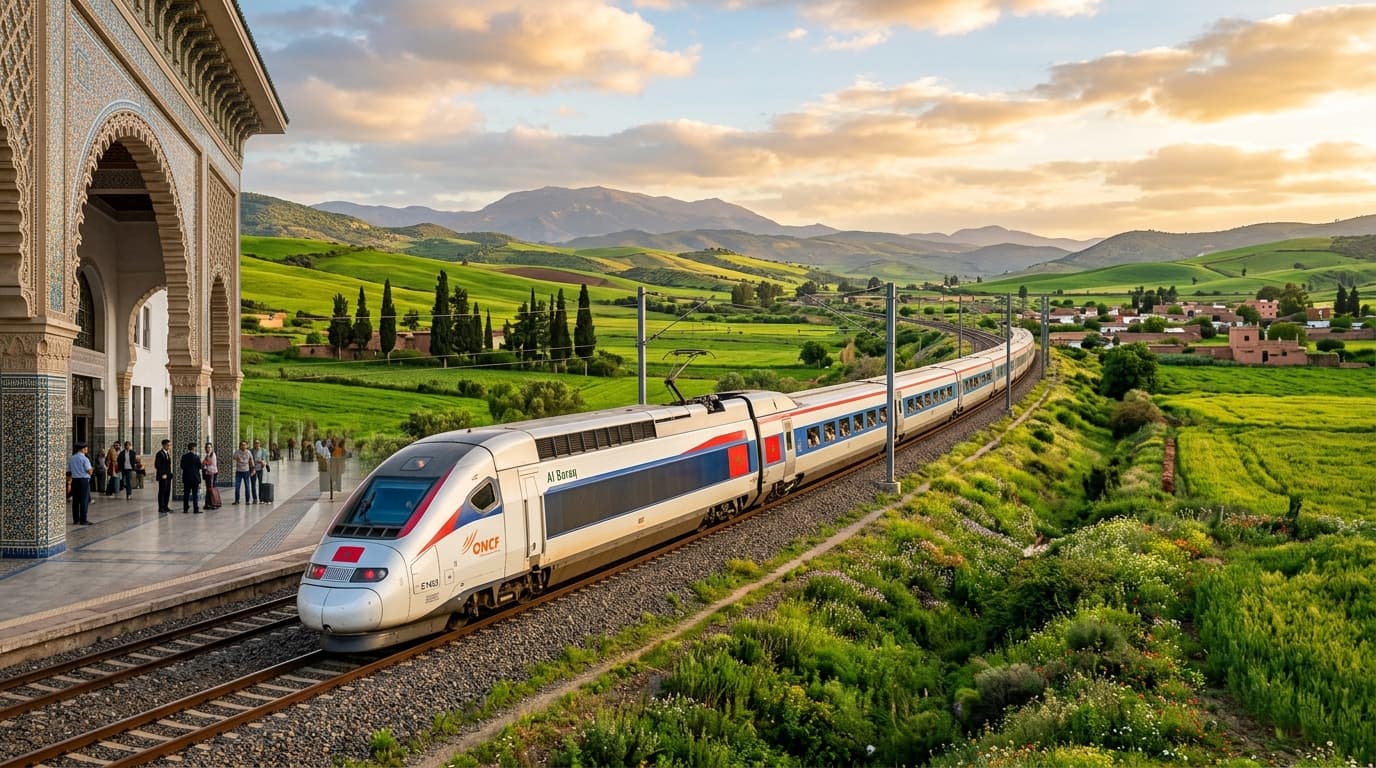
CTM buses are the backbone of Moroccan long-distance public transport: comfortable, air-conditioned coaches that connect all major cities at prices between 60 and 150 dirhams per route. Marrakech to Fez takes around eight hours and costs 100 dirhams. Marrakech to Ouarzazate takes three hours and costs 65 dirhams. Booking via the CTM website two or three days ahead guarantees a seat on popular routes. Grand taxis — the battered but indestructible Mercedes shared taxis that operate between smaller towns — are faster, cheaper per kilometre and fundamentally Moroccan. Six passengers share the cab, each paying for their seat. The correct price is always negotiable down to the shared-seat rate; do not pay for the whole taxi unless you specifically want to travel alone.
The Hammam Is the Best Value in Morocco
A public hammam (neighbourhood bath house) costs 15–25 MAD for entry and an optional extra 20–30 MAD for the kessa (exfoliation scrub with a rough mitt). It is the best way to recover from a travel day, understand Moroccan daily life from the inside, and feel genuinely clean. Ask your guesthouse host for the nearest neighbourhood hammam, not the tourist spa version.
Navigating the Souks Without Haemorrhaging Money
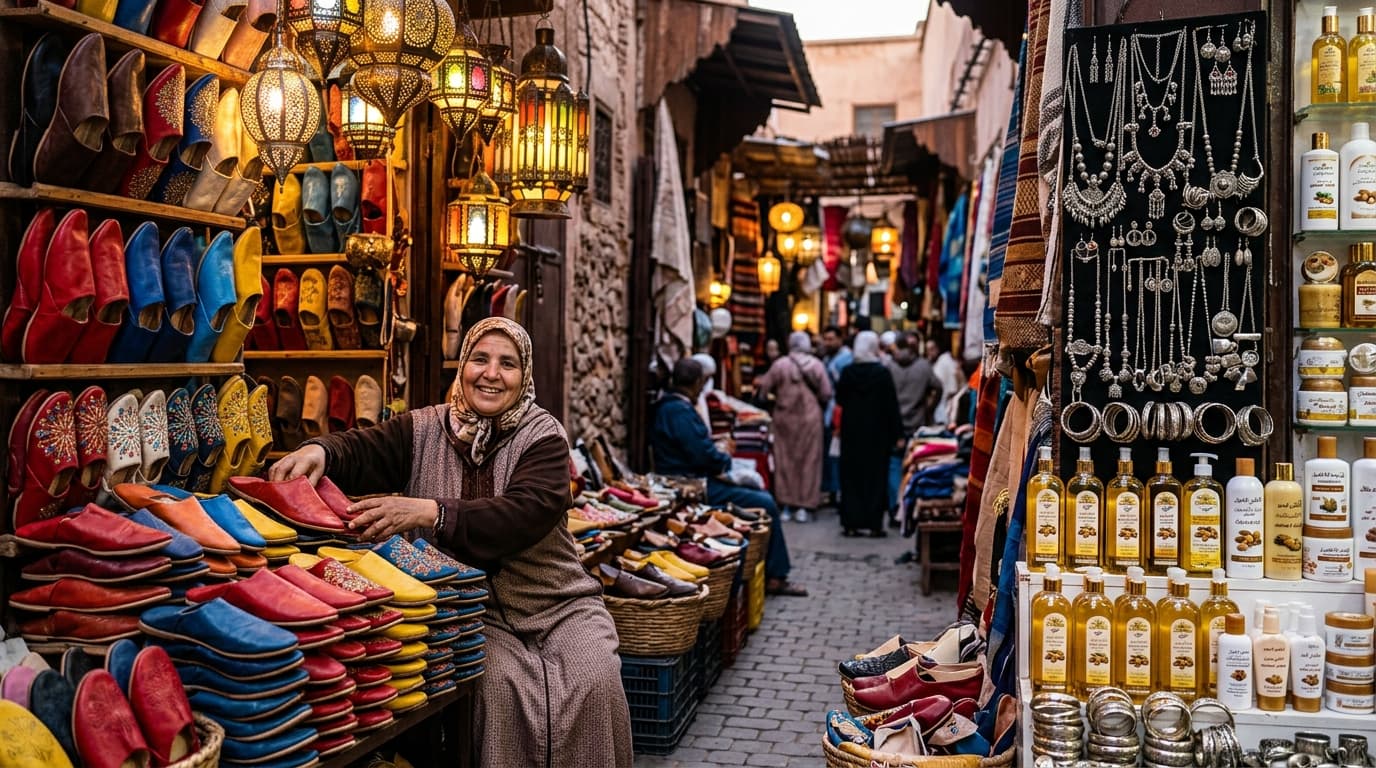
Bargaining in the Marrakech and Fez souks is expected, but it requires a method. The first quoted price for anything in the tourist souks bears approximately the same relationship to fair value as the asking price of a second-hand car: it is a negotiating position, not an honest offer. A reasonable strategy is to offer 40 to 50% of the first price and work toward a number somewhere between 55 and 65% of the original. The golden rule is to never name a price unless you are genuinely willing to pay it, because once spoken it is a binding offer. Walking away is a legitimate tactic and often the most effective. The same carpet, leather bag or ceramic bowl available in the Marrakech souk can frequently be found at a fixed, honest price in artisan cooperatives run by local crafts councils — ask at the tourist office for addresses.
Free and Nearly Free Attractions
Morocco's best experiences cost almost nothing. Walking the medinas is free. Watching the sun set from the tanneries terrace in Fez requires only the purchase of a few dirhams of mint to hold under your nose. The gardens of Marrakech — Menara and Agdal — charge no entry. The Chellah ruins outside Rabat cost 10 dirhams. The Roman ruins at Volubilis, one of the best-preserved Roman sites in the Arab world, charge 70 dirhams. The Hassan II Mosque in Casablanca — the only mosque in Morocco that non-Muslims may enter — costs 120 dirhams for a guided tour and is genuinely one of the great pieces of 20th-century architecture on the continent. Save money everywhere else and do not skip Casablanca simply because it is not on the picturesque Morocco itinerary: the mosque alone justifies the train journey from Marrakech.