Aït Benhaddou is Morocco's most filmed location, a UNESCO World Heritage Site and one of the most visually extraordinary pieces of earthen architecture anywhere on earth. Here is how to visit it properly.
What Aït Benhaddou Actually Is
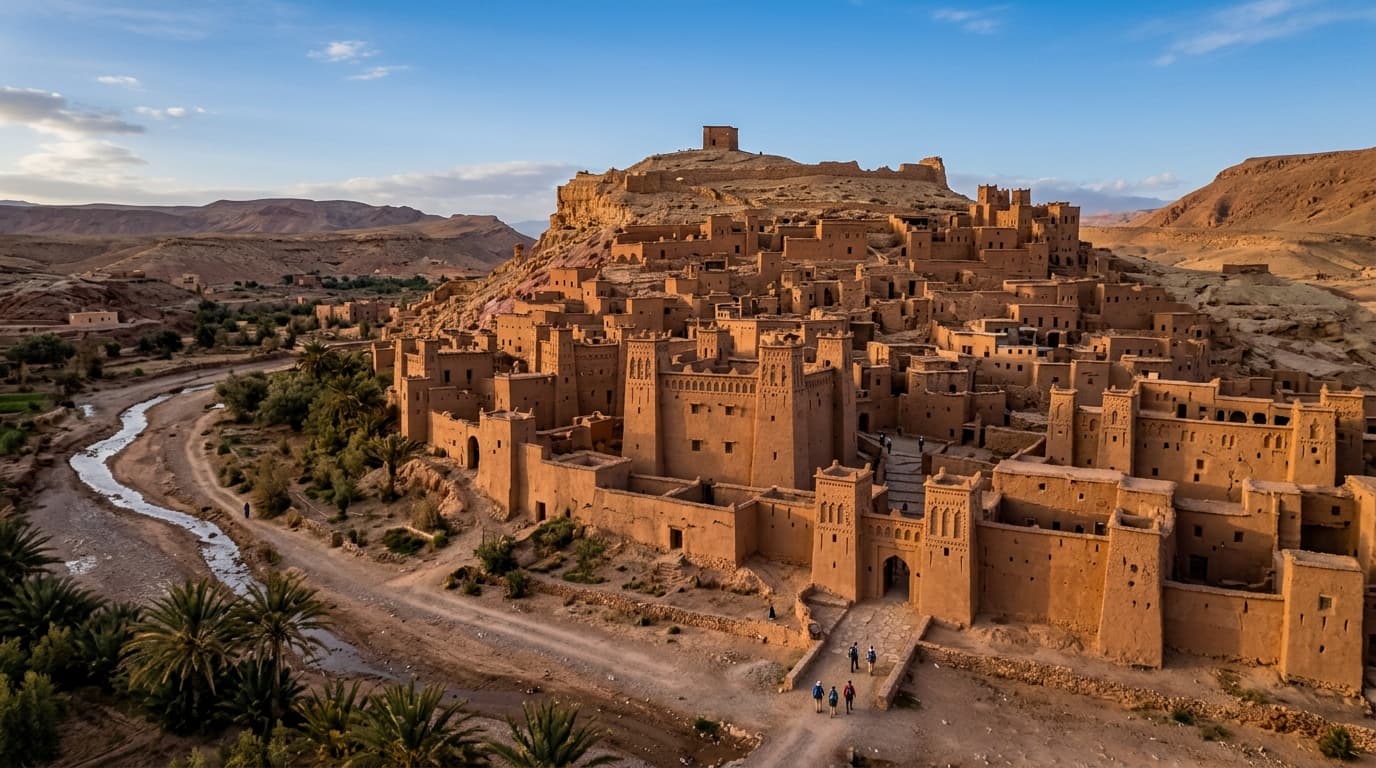
Aït Benhaddou is a ksar — a fortified collective settlement built from rammed earth (pisé), mud brick and gypsum — that sits on a hillside above the Ounila River, 32 km west of Ouarzazate on the road to Marrakech. The settlement was built over many centuries as a stopping point on the caravan route between the Sahara and Marrakech, protected by defensive towers at its corners and perimeter, with a citadel (kasbah) at the summit. At its peak it housed multiple families from the Ounila valley. Today, a small number of families still live in the lower section; the upper ksar is largely uninhabited but maintained.
Aït Benhaddou at a Glance
1987
UNESCO World Heritage listing
32 km
Distance from Ouarzazate
190 km
Distance from Marrakech
10–15 MAD
Entry contribution to village families
20+ films
Major productions filmed here
UNESCO Status and Conservation
Aït Benhaddou was inscribed on the UNESCO World Heritage List in 1987 as an outstanding example of southern Moroccan earthen architecture. The designation recognised both the architectural quality and the fragility of pisé construction, which requires regular maintenance to resist the erosion caused by occasional but heavy Saharan rain events. Conservation work, funded by a combination of Moroccan government investment and international heritage bodies, has stabilised the most vulnerable structures. Sections of the upper ksar are periodically closed during restoration — check current access conditions before visiting.
The Film Connection
Aït Benhaddou's on-screen appearances read like a survey of blockbuster cinema: Lawrence of Arabia (1962), The Man Who Would Be King (1975), Jesus of Nazareth (1977), Gladiator (2000), Kingdom of Heaven (2005), Prince of Persia (2010), and Game of Thrones (where it doubled as the city of Yunkai). The proximity to Atlas Corporation Studios in Ouarzazate — which has the largest permanent film sets in Africa — makes the whole region a perennial production location. A small film museum in the lower village documents the most significant productions and is worth 15 minutes.
I walked up through the ksar in the early morning before any tour groups arrived. The light was orange on the pisé walls and there was complete silence except for a woman grinding grain in one of the lower houses. That image has stayed with me for years.
Crossing the River and Getting In
Access to the ksar requires crossing the Ounila River. In the dry season (May to October), this is a simple walk across a shallow ford or a stepping stone crossing. After winter rain or spring snowmelt (November to April), the river can be waist-deep; a wooden footbridge is the alternative. Entry to the ksar itself carries a small fee of around 10–15 dirhams collected at the foot of the hill. The path up through the lower village to the upper ksar takes 20–30 minutes at a comfortable pace. The summit provides panoramic views of the Ounila valley and the pre-Saharan steppe extending south.
What to See Inside the Ksar
- Lower village craft workshops — families producing pottery, woven baskets and silver jewellery
- Residential mid-section with geometric plasterwork friezes on upper facades
- Narrow shaded alleys, grain storage towers and communal spaces
- Upper citadel — the kasbah proper — with restored sections and panoramic views
- A small Quranic school and prayer hall, open for respectful viewing
- Marked Game of Thrones filming locations in the upper ksar
What to See Inside
The lower village contains several lived-in houses where families produce and sell traditional crafts. The middle section shows the residential architecture of the ksar at its most intact: thick pisé walls with decorative geometric plasterwork friezes at the upper levels, small windows designed to minimise heat penetration, and narrow alleys shaded even at midday. The upper citadel has been partially restored and offers the best views. Allow 90 minutes to two hours for a thorough visit.
Arrive Before 9 a.m. or After 3 p.m.
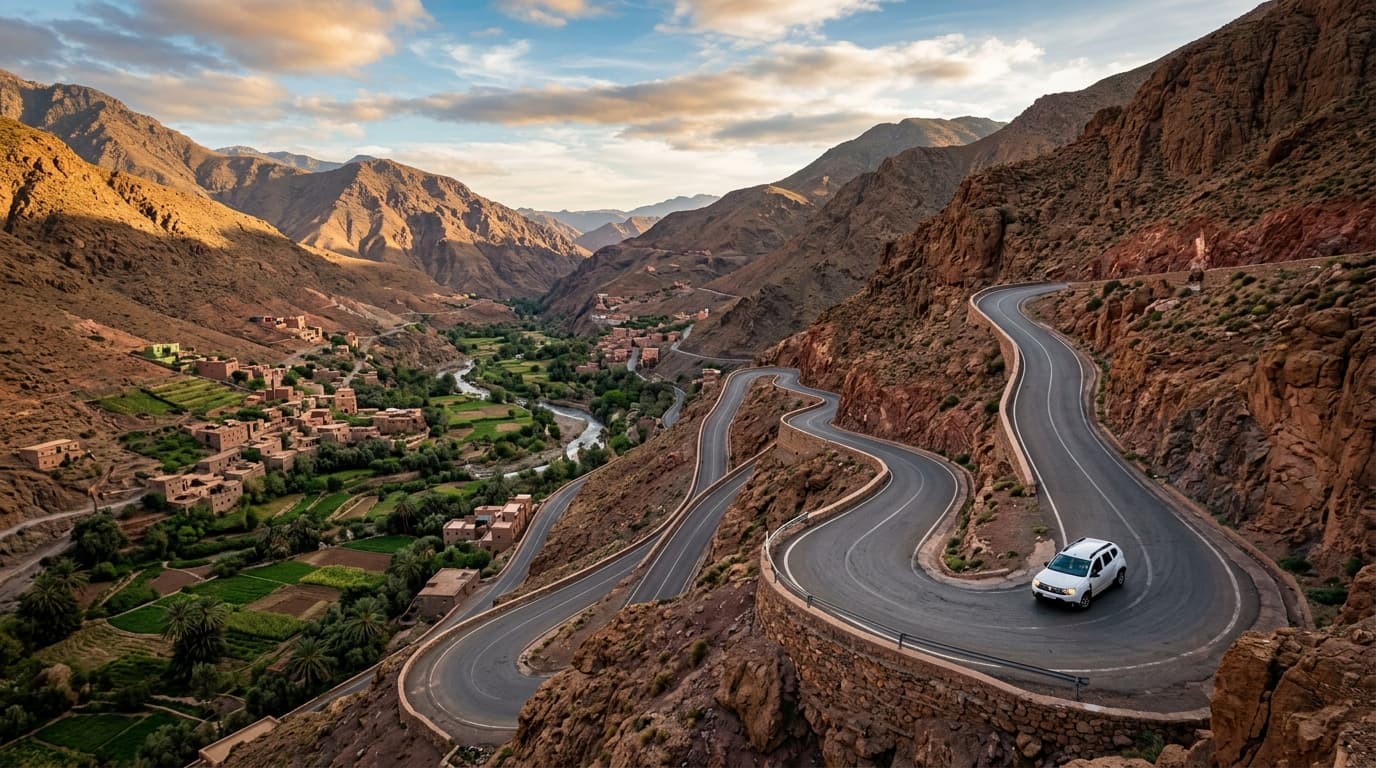
Tour groups from Marrakech arrive between 11 a.m. and 2 p.m. The ksar is busiest in this window and the light is harsh overhead. Early morning gives the best warm light on the pisé walls and a largely empty site. Late afternoon produces long shadows on the towers and the Ounila River turns golden. If staying overnight in Ouarzazate, an early morning visit before driving back over Tizi n'Tichka is the best option.
Ouarzazate: What to Do Before or After
Ouarzazate is 32 km east of Aït Benhaddou and makes an obvious base. The Taourirt Kasbah in the centre of Ouarzazate — once the residence of the Glaoui family — is partially open for guided tours and shows the interior life of a pre-modern Moroccan kasbah in better condition than Aït Benhaddou's largely empty upper shells. Atlas Corporation Studios, 5 km north of town, offers guided tours of its permanent sets and the wardrobe warehouses. The studios are genuinely interesting as a record of cinema history in Morocco's south.
Practical Visitor Information
Opening hours at Aït Benhaddou are roughly 8 a.m. to 6 p.m. daily. There is no official entry fee to the overall site; the 10–15 dirham charge is collected by the village families who maintain the paths. Guides approach all visitors at the river crossing and offer services for 100–200 dirhams — this is optional but useful for those who want historical context. Drinks and snacks are available at several small cafes in the lower village. Accommodation is available at guesthouses on both sides of the river, ranging from 200 to 600 MAD per night.