A night under the Saharan stars sounds romantic — and it is. But arriving unprepared means a miserable dune crossing before you get there. Here is exactly what to pack.
Why the Sahara Demands Specific Preparation
Most travellers arrive in Merzouga having come directly from Marrakech or Fez — cities where the temperature in April or October might be a comfortable 22°C. The Erg Chebbi dunes can reach 38°C during the same afternoon and drop to 5°C by 4 a.m. That 33-degree swing within a single 24-hour period is the planning reality that most packing advice ignores. Add to that fine windblown sand that infiltrates every seal, zipper and electronic port, and you have an environment that punishes casual preparation. The good news is that the gear list is not long — but every item on it earns its place in your bag.
The Numbers You Need to Know
38°C
Daytime Peak
5°C
Pre-Dawn Low
1.5L
Minimum Water Carry
150m
Tallest Erg Chebbi Dune
3 nights
Recommended Stay
Clothing: Layers, Not Bulk
Lightweight merino wool is the ideal base material for desert travel. It regulates temperature in both heat and cold, resists odour across multiple days and dries rapidly after the one wash you will likely manage on a three-night circuit. Bring two long-sleeve merino tops, one lightweight fleece, and one down gilet or thin down jacket for the pre-dawn camel ride. Long linen or cotton trousers are far more practical than shorts: they protect against sun, sand abrasion and the surprising cold of shade in the afternoon. A light cotton shirt that you can button fully closed doubles as sun protection during the dune walk. Avoid synthetic fabrics that trap heat and cling when you sweat.
The Complete Clothing Checklist
- 2x long-sleeve merino wool base tops (dark colours show dust less)
- 1x lightweight fleece or mid-layer
- 1x down gilet or thin down jacket for pre-dawn camel ride
- 2x long linen or cotton trousers (never shorts)
- 1x light cotton shirt that buttons fully closed for sun protection
- 4x merino wool socks (cotton socks collect sand and cause blisters)
- Tagelmust head wrap — buy locally for 60–80 dirhams
- Wraparound polarised sunglasses — not optional
Head and Face Protection
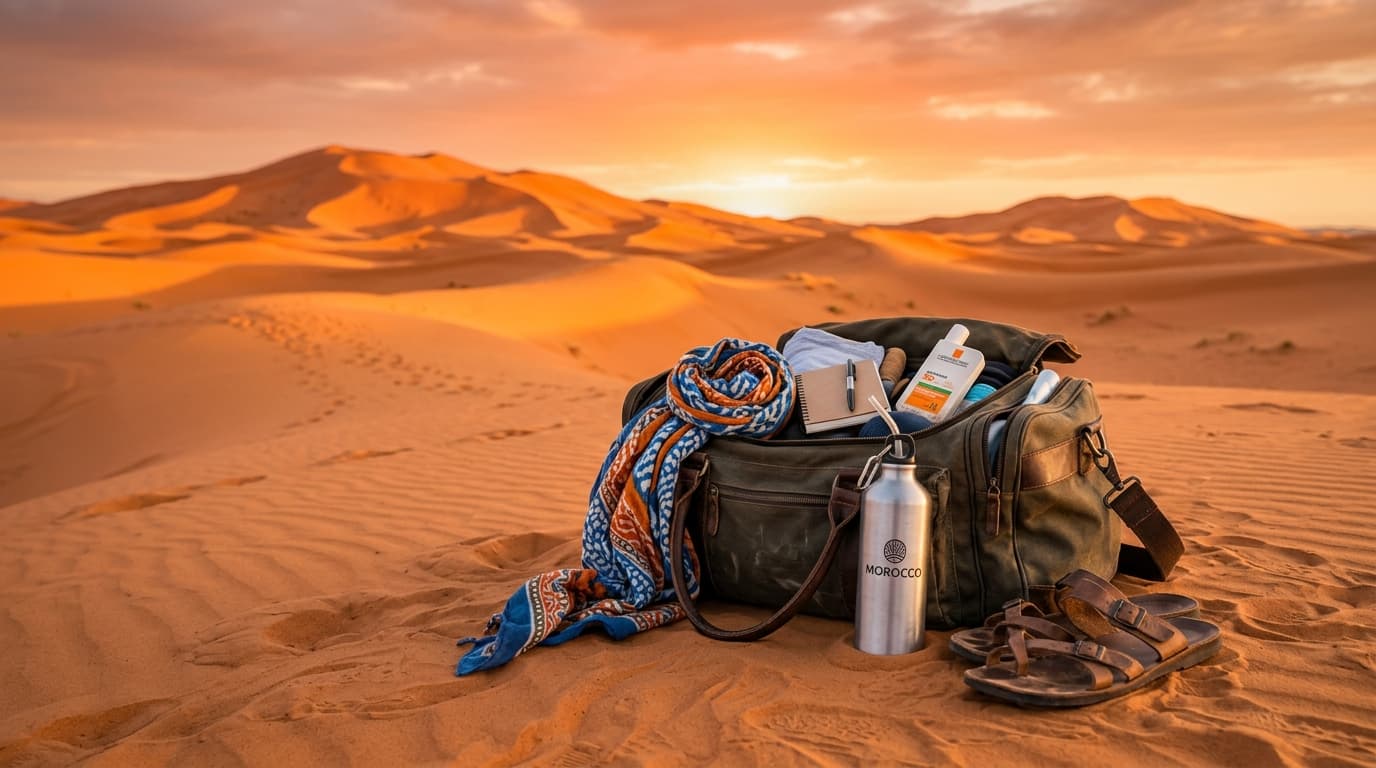
A tagelmust — the traditional Tuareg indigo wrap — is sold at every entry point to Merzouga for around 60 to 80 dirhams, and it is not a tourist gimmick. The 4.5-metre length of fabric allows you to cover your head, protect your face entirely in a sandstorm and use the tail as an extra neck layer at night. Buy one even if you have a sun hat. A pair of close-fitting wraparound sunglasses with polarised lenses is non-negotiable; the reflected glare from sand is more intense than snow glare and UV levels at altitude in the pre-Saharan zone are extreme. Apply SPF 50 to the face, ears and backs of hands, and bring a half-size tube to reapply after sweating.
Footwear and Sand Management
Sandals are impractical for dune climbing — your feet sink and the straps fill with sand instantly. Lightweight low-cut hiking boots with a close-knit upper, or trail running shoes, are the best choice for both the camel journey and any climbing you want to do on the dunes. Bring a pair of light cotton socks specifically for the camel ride; bare feet in stirrups for two hours causes blistering. For the camp itself, flip-flops are welcome weight. On the topic of sand: seal all electronics in zip-lock bags inside your dry bag. Memory cards, charging ports and camera battery compartments are particularly vulnerable. A silicone camera cover is worth the small weight if you plan to photograph the sunrise from a dune crest.
I've guided hundreds of people across the Erg Chebbi. Every single one who ignored the cold warning regretted it by 3 a.m. Bring the down jacket, even in summer.
Hydration and Snacks
Reputable operators provide all water during the trek and in camp, but you should carry at least 1.5 litres on your person during the dune crossing — typically 45 minutes to an hour on foot. A wide-mouth Nalgene or collapsible Platypus bottle is ideal; hydration bladders are harder to keep sand-free. Electrolyte tablets — Nuun or similar — are valuable if you are travelling in May through September when sweat loss is high. For snacks between meals, bring a small supply of energy-dense food that will not melt or crumble: medjool dates are ironically appropriate, mixed nuts, and protein bars with a high cocoa content. The camp meals provided are generally excellent, but long dune days create hunger that the gaps between meals cannot always cover.
Health, Medical and Toiletries
Lip balm with SPF is often forgotten and universally regretted — dry desert air cracks lips within hours. Bring a nasal saline spray if you are prone to sinus issues; the dry air and fine dust affect nearly everyone. Antihistamines are useful for sand-related eye and skin irritation. A small roll of medical tape and a few blister plasters are worth packing for camel-stirrup friction. Moisturiser should be applied generously morning and evening; skin loses moisture rapidly. Toilet paper is provided in camps but bring a small personal supply for rest stops on driving days. Wet wipes are more versatile in the desert than almost any other hygiene product — you will use an entire pack across three days.
Electronics in the Desert
Fine desert sand is fatal to unprotected electronics. Seal every device in a zip-lock bag inside a dry bag. Memory cards are lost every week in Merzouga. A 20,000 mAh power bank will keep you fully charged — camp solar power runs for only 2–3 hours each evening.
Electronics, Power and Valuables
Electricity in Merzouga camps is typically provided by solar panels and available for a few hours each evening; do not rely on charging a laptop. A compact 20,000 mAh power bank will keep your phone and camera fully charged across a three-night stay. Bring a headtorch for navigating the camp at night — the darkness in the desert is absolute and the path between tents and toilet facilities is not lit. A red-light mode preserves night vision for stargazing. Leave expensive jewellery at your riad in Marrakech; there is nowhere to secure it in a canvas tent. A lightweight dry bag — 10 to 15 litres — keeps everything sand-free during transport on camelback and doubles as a pillow case for the camp mat.