The clay tagine pot is one of the world's most elegant cooking technologies. Understanding its regional variations and its nine essential forms will change how you order, eat, and travel in Morocco.
The Clay Pot as Cooking Technology
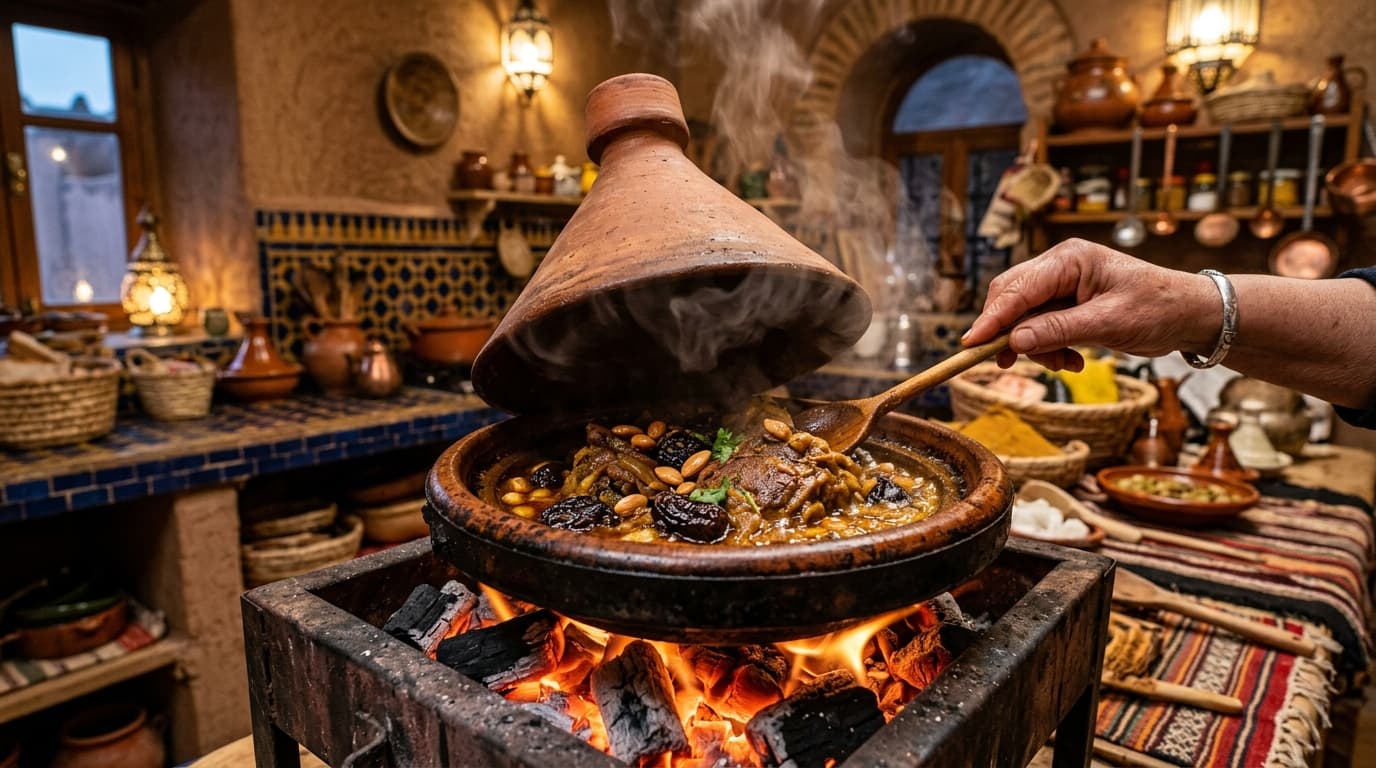
The tagine pot is a piece of engineering as much as it is a kitchen vessel. The conical lid is not decorative. As the liquid inside heats, steam rises, condenses on the sloping interior walls of the cone, and runs back down to baste the meat continuously for two to three hours over a low charcoal fire. The result is meat that has essentially cooked in its own redistributed moisture, absorbing the aromatics around it rather than simply sitting in liquid. A tagine cooked this way has a texture that a pressure cooker or oven cannot replicate: the collagen in the meat dissolves slowly, the vegetables hold their shape, and the sauce reduces into something glossy and concentrated without burning. The question worth asking in any Moroccan restaurant is whether the tagine is cooked in the pot or simply assembled and reheated. The difference is significant.
The Tagine at a Glance
2-3 hrs
Minimum cooking time in a traditional clay tagine
25+
Distinct regional tagine variants in Morocco
60-120 MAD
Typical restaurant tagine price range
1,000+ years
Estimated age of the tagine cooking tradition
The Nine Tagines Worth Seeking Out
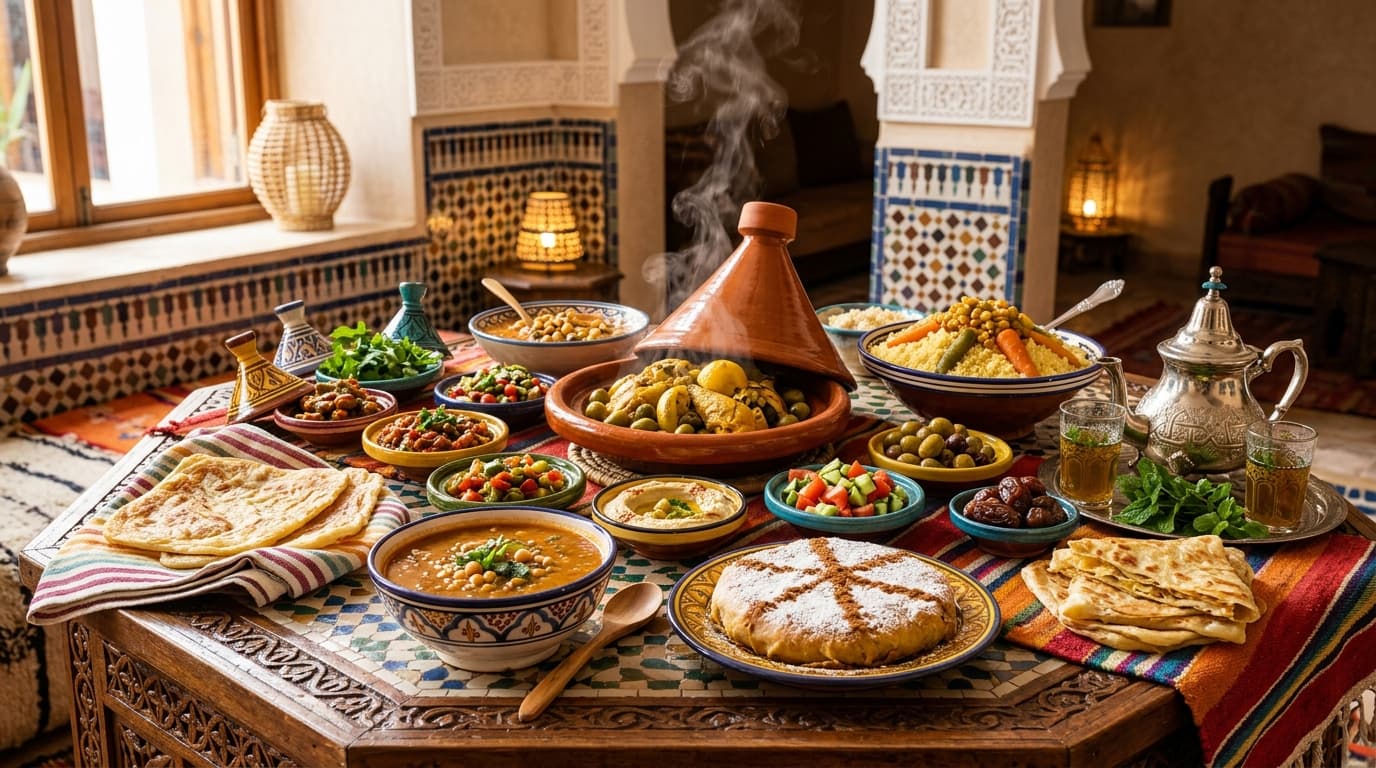
Mrouzia is the most festive of the lamb tagines: slow-cooked with prunes, blanched almonds, honey, and ras el hanout until the sauce turns almost jammy. It appears at Eid celebrations and in the better medina restaurants of Fes and Marrakech. The chicken tagine with preserved lemon and green olives is the most ubiquitous version and also the easiest to judge quality by: the lemon should have fermented into soft brininess rather than sharp citrus, and the olives should still hold their flesh. Kefta tagine with egg is the fast food of tagines — spiced lamb meatballs in a tomato sauce with eggs broken in at the end, cooked in twenty minutes and served bubbling. The Berber goat tagine with potatoes and fresh herbs is the simplest: minimal spicing, rough-cut vegetables, an emphasis on the quality of the meat itself. The fish tagine in chermoula — a marinade of coriander, parsley, preserved lemon, and cumin — is the dish of Essaouira and Agadir: the coastal version, where the chermoula does most of the work. The seven-vegetable vegetarian tagine varies by season and cook, but at its best it is not a lesser option; it is a different genre. Lamb with artichokes is a spring dish, available roughly from March to May, and represents a more delicate side of Moroccan cooking. Oxtail tagine is a winter preparation in Fes: gelatinous, rich, served with crusty khobz for mopping. And the kefkef tagine, less well known to visitors, combines ground lamb with caramelised onions and a mix of spices that leans toward sweetness — it is worth asking for in medina restaurants.
I ordered tagine every single day for two weeks. I was trying to figure out which was best. By the end I had concluded that the answer depended entirely on the clay pot, the charcoal, and the cook's patience.
How to Order a Tagine Well
- Ask whether the tagine is cooked in the clay pot over charcoal or prepared in an oven and transferred — the answer tells you how much time was spent
- Find out what meat is actually available that day rather than trusting every item on the menu is fresh
- In coastal towns always ask about fish tagine first — in Essaouira and Agadir it is often the freshest option
- Request your tagine be brought still on the pot stand, not plated — it continues cooking and arrives hotter
- In restaurants that quote one price, mrouzia and the lamb-artichoke version are often unavailable without ordering ahead by an hour
- Bread is not optional: khobz is the utensil for a tagine, and the sauce deserves to be mopped
Regional Differences That Matter
The Marrakech kitchen leans sweet. The influence of trans-Saharan trade brought dried fruits, saffron, and a comfort with honey in savoury dishes that is more pronounced here than anywhere else in Morocco. Tagines in Marrakech tend toward dried apricot, date, and prune combinations with lamb, and the saucing is generous. In Fes, the spicing is more complex and less obviously sweet: more cumin, more ginger, more layering of aromatics in a way that rewards attention. Fassi cooking is considered the high classical tradition of Moroccan cuisine. The Berber mountain tagine, eaten in villages in the Atlas or High Atlas, strips everything back: one or two spices, fresh herbs, a piece of meat and some potatoes. The simplicity is not poverty but philosophy — let the ingredients speak. On the Atlantic coast from Tangier to Agadir, fish and chermoula dominate, and the tagine functions as a vehicle for the catch of the day rather than a slow-braised meat preparation.
One Thing to Know Before You Sit Down
A traditional tagine cooked over charcoal takes between two and three hours. If a restaurant produces your tagine in fifteen minutes, it was cooked earlier and reheated. This is not necessarily a disaster — many pre-cooked tagines are still good — but it is worth knowing so your expectations match the reality. The best strategy in any medina is to arrive at a restaurant, order your tagine, explore for ninety minutes, and return to eat it properly cooked.