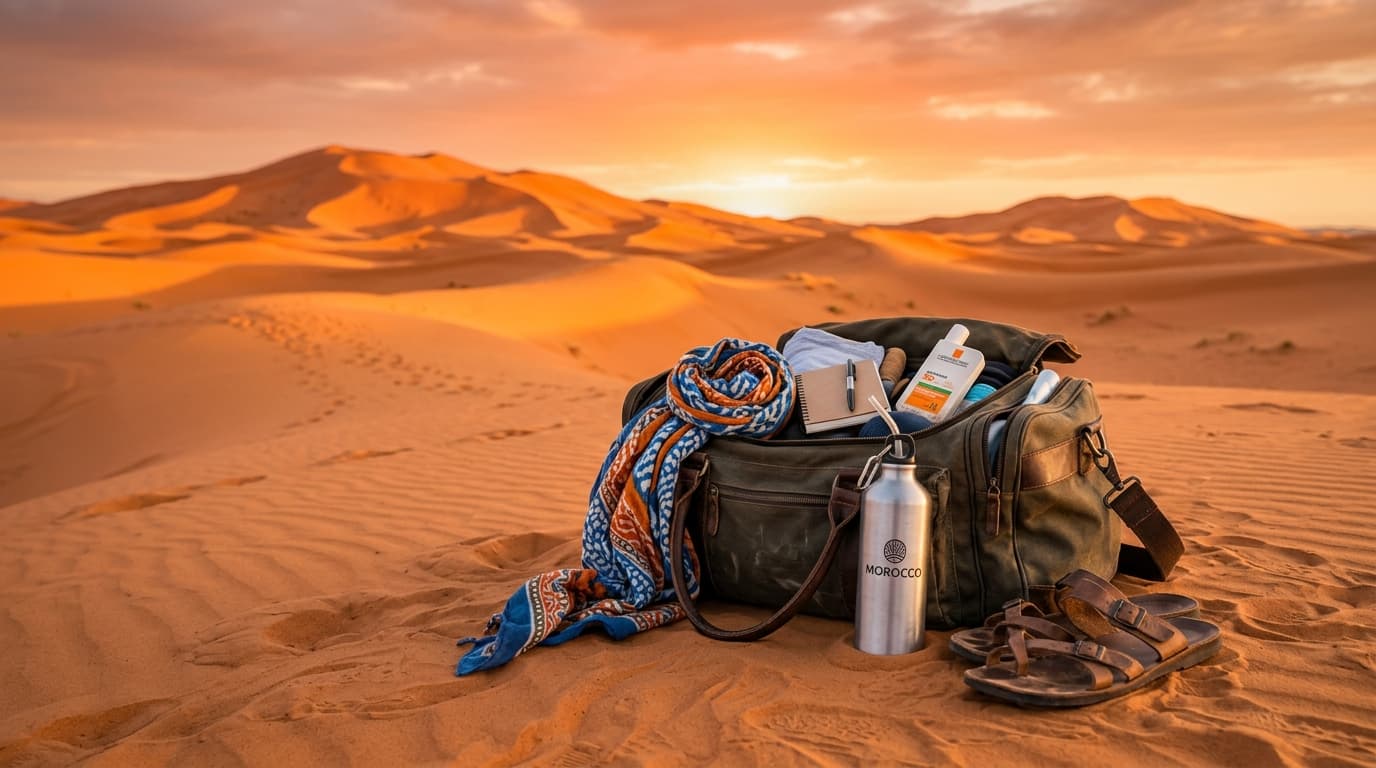
Erg Chebbi's dunes rise 150 metres from flat hamada, turn five different colours before sunset, and take less than an hour to climb. This is the practical guide to doing the Moroccan Sahara properly.
Understanding Erg Chebbi Before You Arrive
Erg Chebbi is not a single dune or a small patch of photogenic sand on the edge of a village. It is a continuous dune field approximately 22 kilometres long and 5 kilometres wide, rising from flat gravel desert at elevations of up to 150 metres above the surrounding plain. The dunes are aeolian — wind-formed — and their shape changes measurably after every storm. They sit on a geological anomaly: the underlying rock formation traps sand blown north from the Algerian Sahara rather than allowing it to continue, which is why Erg Chebbi exists as a defined mass in an otherwise stony landscape. The village of Merzouga, with a population of roughly 3,000, sits at the western edge of the dunes and functions almost entirely as a service hub for desert tourism: guesthouses, camp operators, quad bike rental, and camel handlers.
Erg Chebbi: The Numbers
22km
Length of the dune field
5km
Width at broadest point
150m
Maximum dune height
900 MAD
1-hour quad bike session
1,200 MAD
Luxury camp per person (dinner included)
300 MAD
Budget camp per person (dinner included)
The Colours of the Dunes: When to Be There
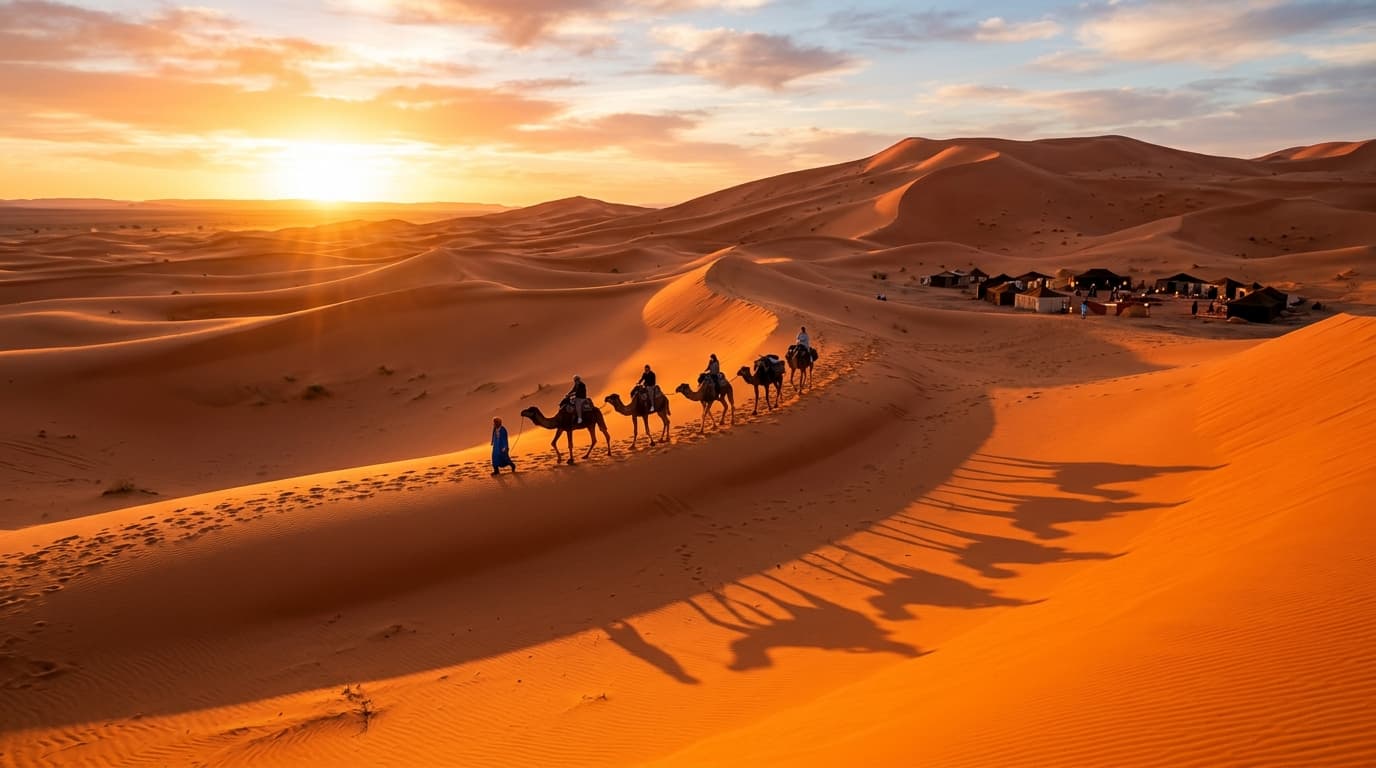
The marketing photographs of Erg Chebbi are almost always taken at sunset, and for good reason: the western face of the dunes catches direct light at around 17:00 and the sand shifts from pale gold at midday to deep copper, then burnt orange, then a brief episode of almost red before the light flattens to grey-brown at dusk. What the photographs rarely show is the dawn experience, which many visitors who sleep in the dunes prefer: at first light the eastern face of the dunes is blue-grey, the sky behind the Algerian border still dark, and the temperature cool enough to climb without effort. The midday hours between 11:00 and 15:00 are the least interesting light-wise and the most punishing heat-wise — sand surface temperatures regularly exceed 60 degrees Celsius in July and August. If you are visiting in summer, arrive at your camp in the late afternoon, climb at sunset, and leave before 09:00 the following morning.
Camel Treks: What the Standard Trip Actually Gets You
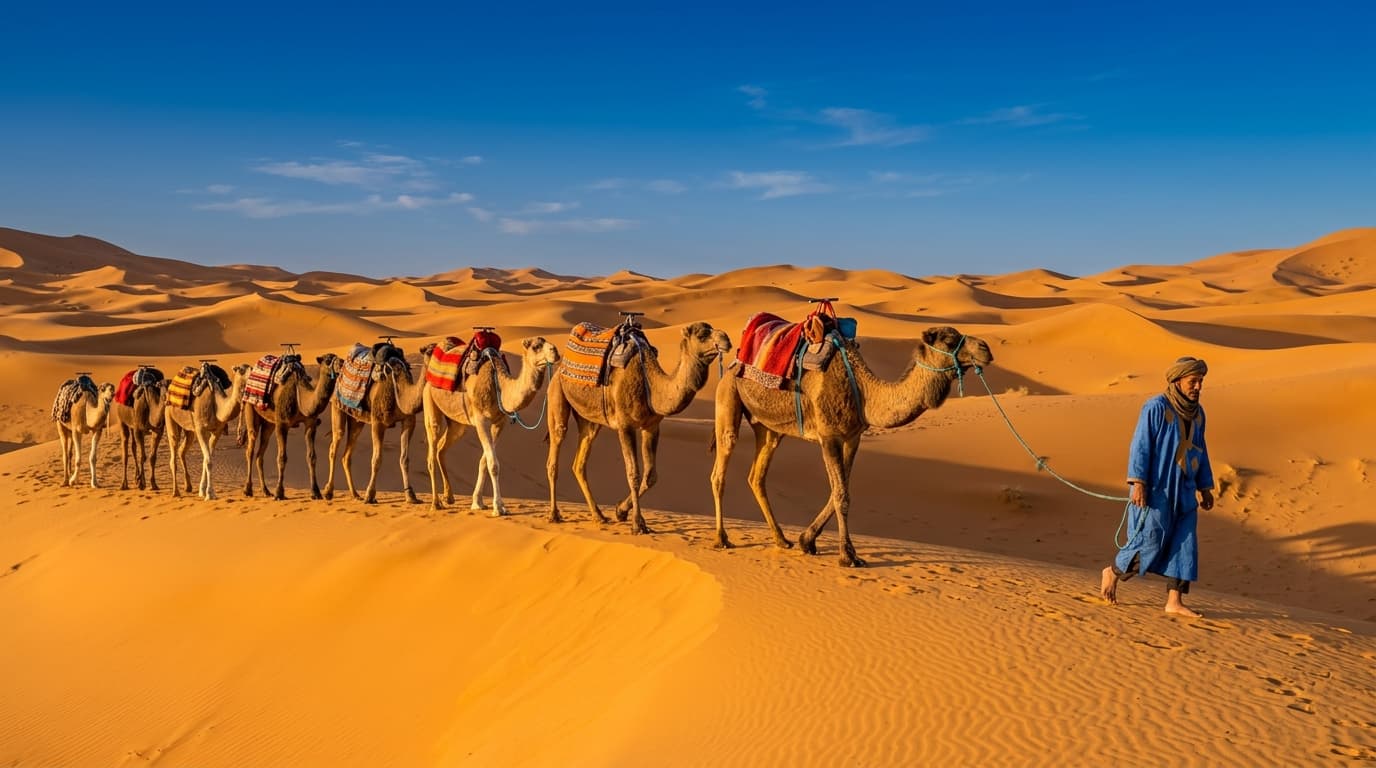
The one-hour sunset camel ride offered by every guesthouse in Merzouga is exactly what it sounds like: a guided line of camels walking from the edge of the village into the dunes and back, timed to arrive at a photogenic ridge for sunset. It is not unpleasant, but it is essentially the same experience offered by every operation along the dune edge, and the camels are working animals accustomed to the route. The overnight trek is a meaningfully different proposition. Departing in the late afternoon, guides lead small groups to camps positioned well inside the dune field — typically 45 minutes to an hour on camelback — where a semi-permanent camp of Berber tents, decorated rugs, and a communal fire awaits. The gap between budget camps (from 300 MAD per person including dinner and breakfast) and luxury camps such as Erg Chebbi Luxury Camp and Nomad Palace (from 1,200 MAD per person) is largely about the quality of the mattress, the bathroom facilities, and the food. The dune experience itself is the same.
We paid for the luxury camp and it was worth it for the private bathroom and proper beds. But the couple in the next tent had paid a third of the price and seemed just as happy with the stars.
Khamlia Village and the Gnawa Musicians
Seven kilometres south of Merzouga along a rough piste, Khamlia is a small village of predominantly Gnawa people — descendants of sub-Saharan Africans brought to Morocco along the trans-Saharan slave routes. The community has maintained its musical and spiritual traditions with unusual coherence, and several families in the village receive visitors for informal Gnawa music sessions: call-and-response singing, the krakebs (iron castanets), and the guembri bass lute in a domestic courtyard, with mint tea and no tour-group pressure. This is genuine community tourism of the kind that is increasingly rare in heavily visited Moroccan destinations. There is no fixed price; a contribution of 50-100 MAD per person is appropriate. Ask your guesthouse in Merzouga to arrange an introduction rather than arriving unannounced.
Getting to Merzouga: Your Options
- From Fes: 8 hours by car via the N13 through Midelt and Er Rachidia — the most scenic drive
- From Marrakech: 9-10 hours via Ouarzazate and the Draa Valley or via Dades Gorge
- From Ouarzazate: 4 hours via Tinghir — the most practical route if flying into Ouarzazate
- CTM bus from Fes: runs to Rissani (30km from Merzouga), connections available
- Shared taxis from Er Rachidia to Rissani to Merzouga: feasible but time-consuming
- Organised tours from Marrakech: typically 3-night itineraries, depart daily
Booking Your Camp: What to Ask
When booking a desert camp, ask specifically: how far into the dunes is the camp located (closer to the village means more light and noise at night), whether the bathroom is shared or private, and what time dinner is served. Camps that advertise 'traditional Berber music' often mean a single musician with a recorded backing track. Khamlia village (7km south) is the place for genuine Gnawa music. Book camps directly rather than through Marrakech tour operators to save 30-50% in commission markups.